Nationwide Personal Property Appraisers
Clear Answers.Confident Decisions.
From one inherited piece to the contents of an entire estate, we help you understand what your property is worth and the next step to take.
Our in-house firm provides personal property appraisals for art, antiques, furnishings, and collections. We bring careful research and clear reporting to estate, tax, insurance, legal, and family decisions.
We do not provide real estate appraisals.

- In-house W-2 appraisal firm
- USPAP-compliant formal reports
- Personal property expertise nationwide
One Firm Behind Your Appraisal.
Knowing who stands behind the work matters. At Prestige, your appraisal is managed within our firm, with research, report preparation, and internal quality assurance and quality control connected throughout the project.
The appraisers you work with are in-house W-2 employees of Prestige Estate Services, not independent contractors.
When a project needs outside specialist expertise, we may engage that support for a defined part of the assignment. Prestige remains responsible for the project and the final report.
You receive the attention of a firm that understands both the property and the decision ahead. Our work is also supported by our professional bonding and insurance.

Complex collections benefit from leadership experienced in coordinating specialists, research, and reporting. That experience helps connect the different parts of an assignment.
An Appraisal Plan That Respects Your Budget
You deserve a clear plan for the work and its cost.
Our personal property appraisers consider why you need the report, what needs to be valued, and where detailed research will be most useful. We explain the scope and fee basis, then look for practical ways to make the project more efficient.

Group Items Where It Makes Sense
Suitable household contents may be grouped by type or room when the assignment allows. This can reduce repeated inventory, research, and reporting work. We consider the property, its condition, the relevant market, and the report requirements before deciding what can be grouped.
Put Research Where It Matters
An everyday dining set and a rare signed piece may need different levels of research. Our appraisers weigh the cost and benefit of added work while giving unusual, valuable, or disputed items the individual attention they need.
We Understand Timelines Are Important
Our appraisers are trained to identify ways to save time and avoid unnecessary expense. Organized records and clear priorities help reduce repeat work. When new findings affect the scope, we discuss the work involved and its effect on fees.
Efficiency still has to support credible results. Our formal appraisals follow applicable USPAP standards, and tax assignments retain the information required for their purpose. For charitable gifts, a grouped appraisal must still include the required information for each item. We plan the work around those requirements.
What Do You Need the Appraisal to Do?
A value is most useful when it answers the right question. Explore the services below, or tell us what you are working through. We will help you find the right starting point.
Jump directly to an appraisal service

Personal Property Appraisals
When you need to know what belongings are worth, start with the reason for the appraisal. A family decision, a tax filing, and an insurance schedule can each call for different research and reporting.
We appraise art, antiques, furnishings, household contents, and collections such as sports cards, coins, and jewelry. Vehicles, machinery, and equipment can also be considered during scope review. We match the work to the property and identify any specialist support needed. Tell us what you have and what you need the value to do.

Tangible Personal Property Appraisals
Tangible personal property means physical belongings, such as a painting, a dining table, a silver collection, or a piece of equipment. The appraisal concerns those items and their relevant market.
We record the details that help identify each object and explain its value. A useful description may include the maker, materials, size, condition, and marks. This gives you a clearer record of what is being valued, especially when several objects look alike.

Fair Market Value Appraisals
An asking price does not establish what an object would sell for. Fair market value considers a willing buyer and seller, relevant market evidence, and the conditions of the assignment.
Our appraisers research comparable property and explain the evidence behind the conclusion. The value is tied to a specific date and purpose. That distinction matters when an estate, donation, or division of property requires a supported opinion rather than an informal price check.

Estate Tax Appraisals
An estate tax return may require a careful valuation of personal property, including art, antiques, jewelry, furnishings, and collections. We work with executors, attorneys, and CPAs to define the property and required valuation date.
Our IRS-qualified appraisers prepare reports that explain the items, market research, and fair market value conclusions. Tell us about filing deadlines and any property that has been moved or distributed. Early planning helps identify the records the appraisal will need.

IRS Form 706 Personal Property Appraisals
For estates filing a federal estate tax return, personal property may need to be valued for Form 706 reporting. We help the executor and tax professional define the contents to include and the effective valuation date.
The appraisal documents the relevant objects and explains the supported values. Your tax advisor determines the estate’s filing obligations and how the return is prepared. Review the IRS Form 706 information and discuss the property scope with our firm before the deadline approaches.

Date-of-Death Appraisals
A date-of-death appraisal gives a value as of the date a person died. It does not simply use what an item might bring today. We review the relevant market at that earlier date and the available evidence about the property.
Old photographs, receipts, prior appraisals, and records of repairs can help. If items have since been sold or dispersed, tell us at the outset. We will assess whether the surviving information supports the work your executor or advisor needs.

Probate Personal Property Appraisals
Settling an estate often means making sense of belongings collected over a lifetime. A probate personal property appraisal gives executors and administrators an organized record of estate contents and supported values for the required purpose.
We help define what should be included and how the property should be documented. Your attorney can identify the court or filing requirements; our firm develops the appraisal scope around those needs. Clear records also help when beneficiaries have questions about the property.

Estate Inventory and Valuation
Before property can be valued or divided, someone needs a clear record of what is there. An estate inventory organizes belongings with descriptions and photographs that make items easier to identify and track.
We discuss which items need separate attention and when logical grouping makes sense. An inventory and a formal appraisal serve different purposes; we can define a project that includes the documentation, valuation, or both. This helps families and fiduciaries plan the work with fewer unanswered questions.

Charitable Donation Appraisals
A gift of art, antiques, or a collection can require more than a receipt from the receiving organization. We prepare personal property appraisals for charitable donation purposes and help define the supporting records needed for the assignment.
Share the proposed gift, recipient, donation date, and your tax advisor’s requirements. Where a qualified appraisal is required, the property, timing, and appraiser qualifications matter. The IRS Form 8283 guidance explains the form used to report noncash charitable contributions.

Insurance Appraisals
When a policy needs a current value for art, antiques, jewelry, or other belongings, the description can matter as much as the number. An insurance appraisal records the details needed to distinguish the property and support the requested value.
We confirm the scope and value definition with you before starting. Replacement-value work differs from fair market value research. A clear report gives you and your insurance professional a stronger basis for discussing scheduling and coverage.

Damage and Loss Appraisals
After water damage, fire, theft, or a transit loss, it can be difficult to establish exactly what was affected. We examine the available property and records to develop the valuation work needed for a personal property claim or dispute.
Photographs taken before and after the event, purchase records, and repair information can all be useful. Our firm includes experience in claim inspection and furniture restoration, helping connect condition questions with the evidence available. Coverage decisions remain with the insurer under the policy.

Divorce and Marital Asset Appraisals
When spouses need to divide belongings, differing ideas about value can slow the discussion. We provide independent personal property appraisals for furnishings, art, antiques, collections, and other marital assets.
The scope reflects the property, access arrangements, valuation date, and needs identified by the client and counsel. Our role is to explain supported values. That gives attorneys, mediators, and clients a clearer basis for comparing property and discussing a settlement.

Equitable Distribution Appraisals
Sentimental importance and market value are different things. When heirs or other parties divide personal property, an independent appraisal helps everyone work from the same documented values.
We identify and value the belongings within the agreed scope so proposed allocations can be compared. Families retain the personal decisions about who receives what. Our work brings a clear record to those conversations, including property that may deserve individual research or separate treatment.

Appraisal Review for Litigation
When an existing personal property appraisal is in dispute, the question is often how the appraiser reached the conclusion. We review the report’s scope, methods, market evidence, assumptions, and explanation of value.
The review can help counsel understand strengths, gaps, and issues that need further examination. We define the review assignment before beginning, including whether a separate value opinion is needed. The work concerns personal property; we do not review real estate appraisals.

Restricted Appraisal Reports
Some clients need a formal value opinion for a limited purpose without the level of explanation found in a fuller report. A Restricted Appraisal Report may be appropriate when its intended use, intended users, and reporting limits have been clearly established.
We first determine whether this format fits the assignment. A shorter report does not remove the need for credible appraisal work. Tell us who will rely on the value and what decision it will support before choosing the report type.

Government and Seized-Asset Appraisals
Public agencies need clear records when valuing seized or forfeited assets, surplus equipment, collections, and other government-held personal property. We define the assignment around the agency’s purpose, access conditions, and reporting needs.
The work can include identifying the assets, documenting condition, researching relevant markets, and explaining the value conclusions. A well-organized inventory supports that analysis and makes the finished report easier for the agency and other intended users to follow.

Furniture, Fixtures and Equipment Appraisals
Businesses and institutions may need values for furniture, fixtures, machinery, and equipment as part of a transaction, financing, insurance, or other planning. We focus on the defined personal property assets and the purpose the report must serve.
Asset lists, model numbers, purchase records, photographs, and condition details help us plan the work. We discuss which assets require individual research and how the final report should organize the conclusions. This appraisal concerns the specified assets, not the value of the real estate or the business as a whole.

Art Appraisals
An artwork’s medium, condition, attribution, ownership history, and market can all affect its value. We appraise paintings, sculpture, prints, and other fine art for the specific purpose of the assignment.
Our firm draws on experience in museum cataloging and primary and secondary art markets. Bring any invoices, exhibition records, prior appraisals, or other documentation you have. Those details help the appraiser understand the work and select relevant evidence, rather than rely on a superficially similar sale.

Antique Appraisals
Age alone does not establish an antique’s value. A maker’s mark, material, repair, or change in condition can make a meaningful difference. We examine the evidence behind the object and research the market relevant to your appraisal.
Our experience in the antiques trade and household-property appraisal helps inform that work. Whether you have a family piece or a varied collection, begin with photographs and the reason you need the value. We will explain the next step.

Furniture Appraisals
Furniture appraisal considers construction, maker, design, age, condition, and the market for the piece. We value individual furnishings and the contents of residences for estate, insurance, division, and other defined purposes.
The firm’s experience with twentieth-century furniture and decorative property adds useful depth when a collection spans different periods. Photographs of labels, joinery, damage, and the full piece can help us plan the inspection and research.

Online Photo Appraisals
Curious about one item? Our Online Photo Appraisal provides an informal estimate of value from your submitted photographs and details. It is handled by one of the appraisers you can find on our Meet Our Appraisers page.
This $79-per-item service is a useful starting point for general questions. It is not a formal appraisal report for tax, legal, insurance, or other formal uses. If you need a report someone else will rely on, contact us first so we can recommend the appropriate service.

Appraisal Fees and Project Scope
Your project should fit the question you need answered. Appraisal fees depend on the items, research, inspection, and report the assignment requires. A few pieces and a whole-home inventory call for different scopes of work.
Share photographs, the approximate number of items, your location, and any deadline. We will help clarify what is involved and explain the next step. The current appraisal fee schedule is the central source for our pricing information.
Good Decisions Need More Than a Number.
You should be able to understand what was appraised, which value was used, and how the conclusion was reached.
For formal assignments, we develop our work under the Uniform Standards of Professional Appraisal Practice (USPAP). We define the intended use—the reason you need the appraisal—and the effective valuation date, which is the date the value applies to.
The resulting report connects the property descriptions, relevant photographs, market research, and value conclusions. It also explains the assumptions and limits that matter to the people relying on it.

Tell Us What You Need
Share the property, location, purpose, and deadline. We clarify who will use the report and what the project needs to cover.
Document the Important Details
We plan the appropriate inspection and records. Condition, marks, measurements, and ownership history can all help identify the objects.
Research the Relevant Market
The appraiser considers suitable comparisons and the factors that affect value. Research is tied to the property, date, and purpose.
Receive a Clear Report
Our internal quality process supports a report that explains the work and its conclusions. You have a documented basis for the next decision.

Remote and In-Person Appraisals
The right approach depends on the evidence your appraisal needs.
Some projects need a direct examination. Others may be completed remotely when photographs, measurements, records, and other information provide enough support. We assess the property and purpose before recommending an approach.
Only need an informal estimate for one item? Our Online Photo Appraisal is a separate service. It offers value guidance from submitted photographs and details, handled by one of our appraisers.
Your Appraisal Questions, Answered.
It is normal to have questions about the property, the process, or the type of report you need. Start with what you know. We will help you work through the rest.

What can Prestige Estate Services appraise?
We appraise art, antiques, furnishings, decorative arts, silver, jewelry, collections, household contents, and other tangible personal property. Our work also includes defined business equipment and government-held assets. Start by telling us what you have and why you need a value. We do not provide real estate appraisals.
Can I have just one item appraised?
Yes. We can discuss a single object, a focused collection, or the contents of an entire estate. If you only want informal value guidance, an Online Photo Appraisal may be a useful starting point. If the value is for a tax filing, insurance, litigation, or another formal purpose, tell us before choosing the service.
Are your appraisers employees of Prestige?
The appraisers you work with are in-house W-2 employees of Prestige Estate Services, not independent contractors. Our firm manages the appraisal and its internal quality assurance and quality control. When an assignment calls for outside specialist expertise, that support is limited to a defined part of the work, and Prestige retains responsibility for the project.
What is the difference between a remote appraisal and an Online Photo Appraisal?
A formal remote appraisal may be possible when photographs, measurements, records, and other evidence are sufficient for the assignment. An Online Photo Appraisal is an informal estimate of value from submitted information. Using photographs does not, by itself, make a service formal or informal. The scope, evidence, intended use, and report determine the approach.
What should I send before we discuss the project?
Start with your city and state, the reason for the appraisal, an approximate item count, and any deadline. A few overall photographs help us understand the property. Tell us about access limitations and share relevant receipts, past appraisals, or other records if available. We will explain what else is needed.
Can you work with my attorney, CPA, or insurance professional?
Yes. With the appropriate authorization, we can coordinate the appraisal requirements with your professional advisors. This helps establish who will rely on the report, the value definition, and the required date. The appraisal supplies a supported opinion of value; your advisors remain responsible for their legal, tax, or coverage guidance.
How soon can my appraisal be completed?
Timing depends on the property, inspection needs, research, report scope, and current scheduling. Tell us about a court date, filing deadline, move, or other time constraint when you first contact the firm. We will discuss the project and confirm a suitable timeline before the work is agreed.
Looking for Personal Property Appraisers Near Me?
Location matters. So do the belongings, the reason for the appraisal, and the firm responsible for the work.

Match the Property
A useful search starts with the items involved. Fine art, household contents, antiques, and business equipment can require different experience. A firm should explain how the work will be matched to the property.
Match the Purpose
An appraisal for estate tax differs from one for insurance or an informal value question. The provider should establish the required value, date, intended users, and report before the project begins.
Confirm the Plan
Clients should confirm the inspection approach, records needed, scope, fees, and timing. Prestige coordinates personal property appraisal assignments nationwide and can discuss the appropriate next step for a specific location and project.

Let’s Make Your Next Step Clear.
Tell us what you have, where it is, and why you need an appraisal. We will help you understand the work involved and how to get started.
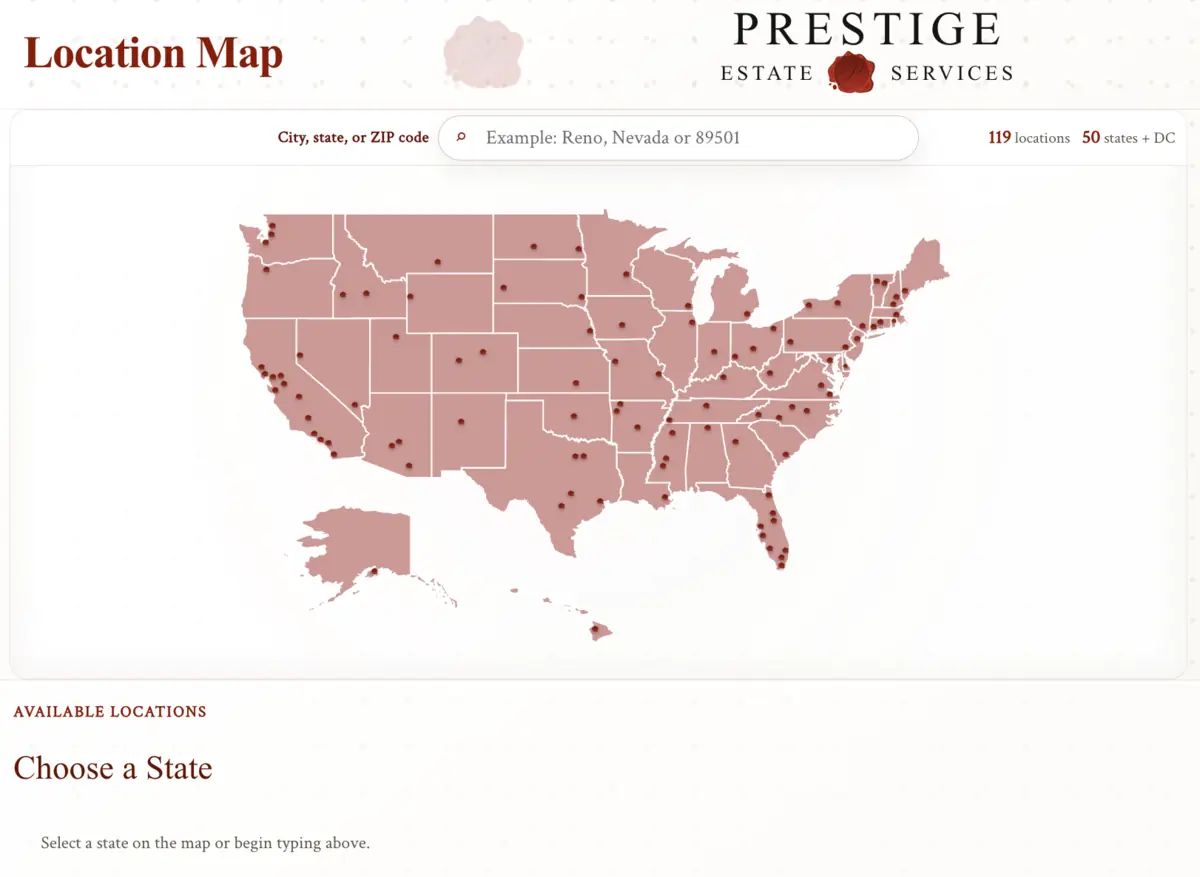
Find an Appraiser by Location.
Explore our locations, then contact the firm with your property and project details. We will discuss the appropriate scope and whether on-site or remote appraisal work fits your needs.