Furniture Appraisers for Personal Property
Furniture appraisers identify and value antique, vintage, designer, custom, and contemporary furnishings for a defined intended use. Prestige Estate Services documents the property, researches relevant markets, and develops supported opinions of value for estate, insurance, donation, division, litigation, and private planning needs. An assignment may address one significant piece, a collection, or furniture throughout a residence.
Prestige Estate Services appraises tangible personal property. We do not provide real estate appraisals.

Purpose First
The intended use guides the value definition, effective date, research, and report format.
Furniture Specific
Construction, maker, materials, condition, originality, and market demand are considered as relevant.
Scope Matched
The appropriate onsite, remote, or hybrid pathway is determined after the property and assignment needs are reviewed.
Meet Our Personal Property Appraisers
All Prestige Estate Services appraisers are in-house W-2 employees. We do not use contract appraisers as members of our appraisal staff. Each appraiser works directly for Prestige Estate Services and is IRS-qualified and USPAP-compliant.

What Does a Furniture Appraiser Evaluate?
A furniture appraiser studies the characteristics that identify a piece and connect it to the appropriate market. The analysis may include form, construction, materials, joinery, hardware, labels, signatures, maker or designer attribution, production date, dimensions, condition, alterations, restoration, provenance, and current demand.
Object Identification
The appraiser records what the piece is, how it was made, and which observable features or documents support its identification. Sets, suites, and paired objects are also evaluated for completeness and consistency.
Relevant Market Research
Comparable sales and other market evidence are selected for the assignment's value definition and effective date. The market used for an insurance assignment may differ from the market appropriate to another intended use.
Condition and Originality
Wear, repairs, replaced elements, refinishing, upholstery, structural stability, and evidence of restoration may influence both identification and value. Age alone does not establish market value.
Supportable Attribution
Marks, labels, documented history, construction details, and published references may support an attribution. The appraiser explains material assumptions or limitations when evidence is incomplete.
Prestige Estate Services Locations Map
Prestige Estate Services provides and coordinates personal property appraisal services across the United States. Share the city and state where the furniture is located so the assignment scope and appropriate inspection pathway can be reviewed.

What Types of Furniture Can Be Appraised?
Furniture appraisal assignments may include an individual item, a coordinated suite, a collection, or furnishings distributed throughout a residence. The appraiser reviews the categories, volume, documentation, location, and intended use before confirming whether the proposed scope is appropriate.
- Antique case furniture, tables, seating, desks, and cabinets
- Vintage and mid-century modern furniture
- Designer and studio furniture
- Custom and commissioned pieces
- Contemporary and luxury furnishings
- Upholstered furniture and coordinated suites
- Asian, European, American, and regional furniture
- Outdoor, garden, and architectural furnishings that remain personal property
- Furniture collections and household inventories
- Furniture with documented maker, ownership, or exhibition history
Is the Furniture Used in a Business or Institution?
Furniture that is part of a commercial, hospitality, nonprofit, government, or institutional asset inventory may require a broader Furniture, Fixtures & Equipment appraisal. Prestige Estate Services can review the intended use and property list before directing the assignment.
How Do Maker, Design, Condition, and Market Affect Value?
Furniture value develops from the relationship among the object, the assignment conditions, and the relevant market. A well-known maker can matter, but attribution, model, materials, date, condition, originality, rarity, completeness, provenance, scale, transport considerations, and buyer demand may all change how comparable evidence is interpreted.

Maker and Design
A documented maker, designer, model, workshop, or manufacturer may help define the correct comparison group. Labels and signatures are considered with construction and other evidence rather than in isolation.
Condition and Restoration
Structural repairs, refinishing, replacement hardware, altered surfaces, stains, losses, fading, upholstery changes, or later additions may affect desirability and comparability.
Provenance and Documentation
Receipts, invoices, prior appraisals, photographs, correspondence, exhibition records, and family history may help establish identity or ownership history when the records can be evaluated.
Market and Effective Date
Values are tied to a defined date and value premise. The appraiser researches market evidence that is relevant to those assignment conditions rather than applying a generic price estimate.
Why Does the Intended Use Matter?
The intended use establishes what question the appraisal must answer and who is expected to rely on the report. It also influences the appropriate value definition, effective date, scope of work, inspection needs, market selection, research, and reporting detail. For that reason, a value developed for one purpose should not automatically be reused for another.
Formal Reporting Needs
Furniture may require a documented opinion of value for estate administration, tax-related work, insurance scheduling, damage or loss analysis, equitable distribution, charitable contribution support, litigation, fiduciary decisions, or private planning.
Informal Item Questions
If the goal is simply to learn more about one or a few items, an informal Online Photo Appraisal may be a practical starting point. It is not a substitute for a formal appraisal needed for legal, court, IRS, fiduciary, insurance-claim, or other formal intended uses.
How Does the Furniture Appraisal Process Work?
The process begins by confirming why the appraisal is needed, which furniture is involved, where it is located, the relevant date, who will use the report, and whether instructions have been supplied by an attorney, CPA, fiduciary, insurer, court, or other intended user.
1. Scope Review
Prestige Estate Services reviews the intended use, item count or household volume, location, deadline, available records, and any assignment-specific requirements.
2. Inspection Pathway
An appraiser determines whether onsite inspection, remote documentation, or a hybrid approach is appropriate. The pathway is based on the assignment, not selected as a default convenience option.
3. Identification and Research
The furniture is photographed and described as appropriate. Measurements, marks, materials, construction, condition, provenance records, and relevant comparable evidence are reviewed.
4. Analysis and Reporting
The appraiser reconciles the evidence, develops the applicable value conclusion, and prepares the reporting format required by the agreed scope of work.
What Does a Furniture Appraisal Report Include?
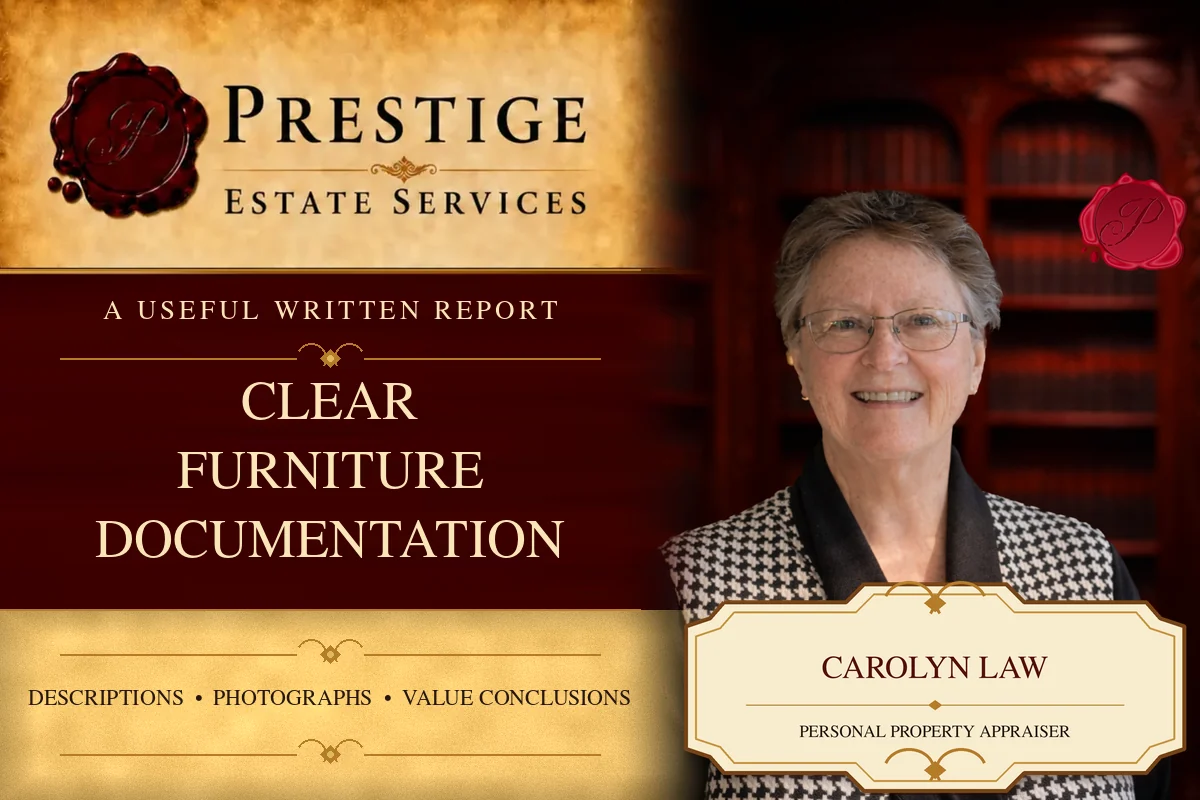
A written furniture appraisal report identifies the assignment and explains the basis for the appraiser's conclusions. The exact format depends on the intended use and scope, but the report commonly addresses the client and intended users, effective date, value definition, scope of work, property identification, photographs, condition observations, market research, analysis, assumptions, limiting conditions, and value conclusions.
What to Send
Provide the intended use, effective date when known, city and state, deadline, approximate number of pieces, overview photographs, and any receipts, labels, measurements, prior appraisals, ownership records, repair records, or professional instructions already available.
What Affects Timing and Fees
Project size, furniture complexity, access, travel, documentation quality, inspection pathway, research requirements, report type, effective date, and deadline can affect the assignment. Prestige Estate Services reviews the scope before providing the applicable engagement, estimate, or retainer information.
Furniture Appraisal Questions
Can an appraiser value furniture throughout an entire home?
Yes, a scope may include furnishings throughout a residence as well as individual high-interest pieces. Send an approximate home size, room count, property categories, and overview photographs so the volume and documentation needs can be reviewed.
Should furniture be repaired or refinished before an appraisal?
Do not make an irreversible change solely to prepare for an appraisal. Refinishing, replacing hardware, reupholstering, or repairing a piece can affect originality, condition, and value. Photograph the current condition and discuss the proposed work with the appraiser before proceeding.
What if the maker or age is unknown?
Unknown information is common. Photograph the complete piece, underside, back, interior, joinery, hardware, labels, stamps, signatures, damage, and any unusual construction. Include measurements and documents without guessing at a maker or date.
Does Prestige Estate Services buy or sell the furniture it appraises?
No. Prestige Estate Services provides independent personal property appraisal services and does not make an offer to purchase the furniture being appraised.
Can one appraisal conclusion be used for every purpose?
Not necessarily. A value conclusion is developed for a stated intended use, intended users, effective date, value definition, and scope of work. Contact Prestige Estate Services before relying on an earlier report for a new decision or reporting context.
Discuss Your Furniture Appraisal
Tell us why the appraisal is needed, where the furniture is located, the approximate number of pieces, the deadline, and what photographs or records are available. Prestige Estate Services will review the information and identify the appropriate next step.