Restricted-use appraisals
Restricted Appraisal Reports for Personal Property
Meet Prestige Estate Services
A Restricted Appraisal Report provides a concise written valuation for a defined purpose and identified users. Often called a restricted-use appraisal, it may suit decisions about selected belongings, inherited collections or sale planning. Prestige Estate Services helps determine whether this reporting option fits your needs before work begins. A shorter report still requires credible appraisal work.
Prestige Estate Services appraises tangible personal property. We do not provide real estate appraisals.
The people behind the appraisal
Meet Our Personal Property Appraisers
Choosing a concise report starts with choosing an appraiser who understands the property and the decision ahead. Our team discusses the items, available records and people who will use the results. That conversation helps establish a practical scope before inspection or research begins.

All Prestige Estate Services appraisers are in-house W-2 employees. We do not use contract appraisers as members of our appraisal staff.
Understand the reporting choice
What Is a Restricted Appraisal Report?
Restricted Appraisal Report is the formal reporting label used here. Restricted-use appraisal is a familiar phrase for the service. The report identifies who may rely on it and the purpose it serves. It is a written appraisal, even when it contains less explanation than another reporting option.

The Uniform Standards of Professional Appraisal Practice (USPAP) provide the professional framework for these reporting choices. Personal property reporting is addressed in Standard 8. The International Society of Appraisers explains the named-user requirements for the restricted option.
Start with the decision
When Can Concise Reporting Be Useful?
The right starting point is a clear question about the property. A focused report may help when the reader needs a value conclusion for a specific planning decision. The examples below are possible uses to discuss during consultation, rather than automatic approvals for this format.

Inherited Collections
An owner may need help deciding which inherited objects to keep or research further. A defined list can separate that planning task from a later estate filing.
Sale Planning
Value guidance may help an owner consider a sale or consignment. The appraisal does not promise a selling price, a willing buyer or a particular auction result.
Collection Decisions
A collector may want values for selected works before changing a collection. Records of the objects and their condition help make that question more precise.
Advisor Discussions
A client may want a report for a specific planning conversation with an advisor. Identify that person and the proposed use before the appraiser recommends a format.
Fine art, antiques, furniture, decorative objects, jewelry, silver and collectibles may be included when they fall within the agreed work. Tell us about unusual pieces or specialist categories early so we can assess the property expertise needed.
Define the work before it starts
How Can the Scope Control Appraisal Costs?
A useful scope states which belongings will be valued and which will remain outside the report. That can mean a single collection, selected rooms or a numbered item list. Clear boundaries let the appraiser plan the work and help the client understand what the quoted fee covers.
- Identify the rooms, categories or individual objects to include, using photographs or an inventory where available.
- Agree on a review order when the property is spread across several rooms or storage areas.
- Discuss any proposed value threshold and how items will be assessed against it.
- Record items that are excluded or not reached, so a partial assignment is not mistaken for a complete contents valuation.
- Agree on how additional work will be discussed if access, research needs or the item count changes.
A time budget does not establish the value of items that were never examined. Likewise, a reporting threshold cannot rest on an unsupported guess. If the proposed limits prevent credible results, the appraiser will need to revisit the scope with the client.
The reporting choice and the work needed to support a value are separate decisions. A concise document may save writing time, but complex objects can still require substantial research.
Match access to the property
On-Site or Remote: Which Approach Fits?
The restricted report option does not decide whether an inspection is needed. That choice depends on the objects, the quality of the available records and the information required to value them. Share photographs before scheduling so we can discuss the best way to document the property.

Remote Documentation
Clear photographs and reliable records may be enough for some focused projects. Include multiple views, measurements, identifying marks and condition details so the appraiser can assess any gaps.
On-Site Inspection
A visit may help when there are many objects or details are difficult to capture in photographs. Access to storage, frames, labels and related records helps us plan the visit.
For a remote submission, show the whole object and close views of signatures, labels, hallmarks, damage and repairs. Add receipts, earlier appraisals and ownership history if available. Avoid cleaning, repairing or moving fragile objects solely to improve a photograph.
If images leave a material question unresolved, further documentation or direct inspection may be needed. We confirm the pathway after reviewing the project rather than treating every restricted-use appraisal as an online service.
Know what the document covers
What Will the Written Report Explain?
The finished document should make the boundaries of the valuation clear. Read the property list alongside the stated purpose, date and limitations. An omitted item is not assigned a zero value, and a value for selected pieces should not be read as a total for everything in the home.

Fair market value may be appropriate for some planning needs, but it is not an automatic choice for every project. A resale decision and an insurance replacement question can call for different value bases. Explain the actual decision so the appraiser can select and define the relevant one.
From inquiry to written results
How Does the Appraisal Process Work?
Send a brief description of the property, its location and the decision you need to make. Include your deadline and any instructions from a person who expects to use the report. We can then discuss the scope and whether restricted reporting is a suitable starting point.
Discuss the Need
Describe the objects and the reason for seeking values. Identify the client and anyone else expected to rely on the document before choosing the reporting option.
Confirm the Scope
Agree on the property list, access, value date and proposed deliverable. Review the fee and explain any time limits or exclusions before work begins.
Document and Research
The appraiser gathers the relevant item details and studies market evidence. Missing records or identification questions may require follow-up before value conclusions can be reached.
Receive the Report
Read the completed document with its property list and stated boundaries. Raise questions about its contents and discuss any new purpose before sharing it for broader use.
Have an existing inventory? Send it with the inquiry, even if some entries are incomplete. A simple room-by-room list and representative photographs often make the first scope discussion more useful. Do not send original ownership papers unless we have arranged how they will be handled.
Choose the right report from the start
Fees and Situations That Need More Detail
Fees depend on the property, the number of items, available documentation, access and the research needed. The amount of reporting is one part of that work. Request a scope discussion instead of assuming that a restricted report always has a fixed price or faster turnaround.
Work That Affects Fees
Unidentified makers, unusual objects and incomplete ownership records can add research time. A clear inventory helps organize the work, but reliable evidence is still needed.
Broader Reporting Needs
A filing, claim or disputed matter may require more explanation or specific information. Share the recipient’s instructions so we can assess the format before work begins.
See our appraisal fee information for general guidance. We discuss project pricing and timing after reviewing the proposed work. Any later request to add items or change the purpose may require additional research and reporting.
If the project concerns probate administration, estate-tax reporting or a charitable donation appraisal, start with that service’s requirements. The report label alone does not establish whether a filing or recipient’s documentation needs are met.
Practical questions
Restricted Appraisal Reports for Personal Property: Additional Questions
Is this an informal estimate?
No. This is a written appraisal service with an agreed property scope and purpose. Ask what the proposed document will cover so you can distinguish it from a casual opinion, a sales offer or an auction estimate.
Who can use the report?
Use is restricted to the client and any additional intended users identified by name. Discuss all expected users at the outset. Giving someone a copy does not, by itself, make that person an intended user.
Can a few items be valued?
Yes, the project can cover selected objects or categories. Identify them before work begins. Values for those pieces should not be treated as a total for all household contents.
Does a short report mean less research?
Not necessarily. The property and valuation question determine the research needed. A shorter document does not resolve uncertain identification or remove the need for reliable market evidence.
What if my plans change?
Ask the appraiser before changing the purpose or audience. New needs may require more research or a different report. Changing the title alone does not resolve that question.
How soon can I receive it?
Share your deadline when you inquire. We can discuss a schedule after reviewing the item count, access and records. Research needs and current availability also affect the timing.
Do you value the house too?
No. This service addresses tangible personal property, such as furniture, art, jewelry and collections. A house, land or other real property needs a separate real estate appraisal professional.
Choosing the right appraisal service
Searching for Restricted-Use Appraisers Near Me?
Finding a nearby provider is only part of choosing this service. A useful comparison also considers the kinds of belongings involved and the report the client needs. The following questions help separate personal property expertise from proximity alone.
Match the Appraiser to the Objects
A prospective client should describe the collection and ask about experience with those property categories. An art collection, jewelry group and household furniture inventory can present different research needs. The provider should explain how that work will be covered without implying that a nearby office proves relevant expertise.
Confirm the Report and Its Audience
The client or advisor should ask whether a Restricted Appraisal Report fits the planned decision. The discussion should identify who needs the document and what information they need from it. Any filing instructions or recipient requirements should be supplied before selecting a concise format.
Check Access, Scope and Delivery
Before scheduling, the prospective client should confirm which items are included, what photographs or records are needed and whether a visit is appropriate. The fee proposal should also explain the deliverable, timing and handling of added work. National coverage does not establish availability for every project or date.
Start with a scope discussion
Discuss Your Restricted Appraisal Report
Tell us which belongings you need valued and how you plan to use the results. Include the location, a few representative photographs and any deadline. We will review the request and explain the reporting options for a possible engagement.
Nationwide personal property appraisal support
Find a Personal Property Appraiser by Location
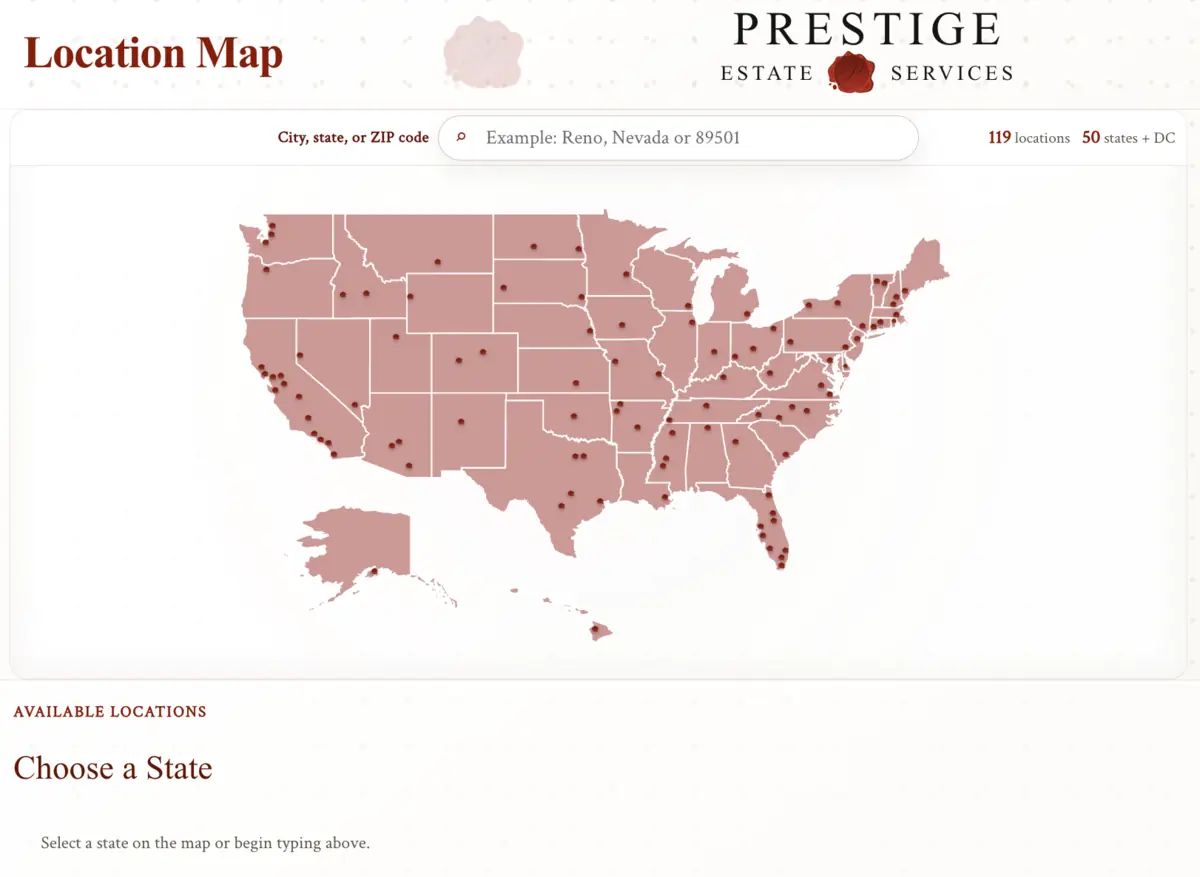
Prestige Estate Services provides personal property appraisal services nationwide. Explore our locations to begin an inquiry about your area, then confirm project availability and the appropriate inspection or remote documentation approach with our team.