
When claiming charitable donation deductions on your tax return, it’s crucial to have an appraisal of your personal property that complies with IRS regulations. The IRS has strict rules for documenting and valuing donated items, which is why professional appraisals are necessary for significant non-cash contributions.
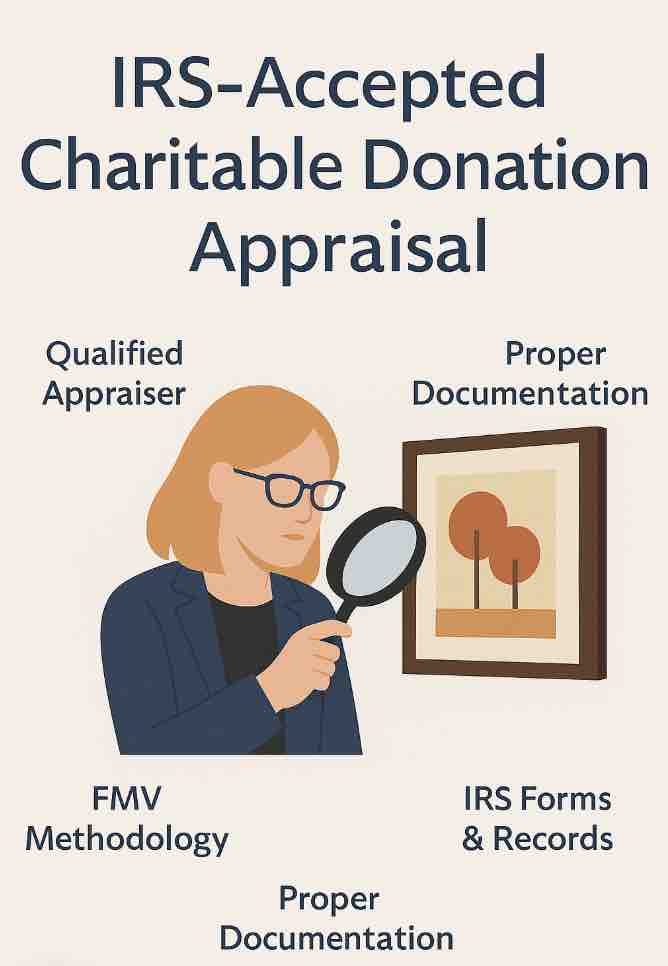
A qualified appraisal for charitable donations serves several purposes:
- Tax Compliance: It meets the IRS requirements for documentation when claiming deductions.
- Legal Protection: It provides a defensible valuation in case of an audit.
- Accurate Valuation: It ensures that the fair market value of the donated items is determined correctly.
- Charitable Organization Support: It helps non-profit organizations properly record the donations they receive.
To obtain an appraisal that the IRS will accept, you need to follow these steps:
- Engage a qualified appraiser who has recognized credentials.
- Document the details and condition of the items being donated.
- Use approved methodologies to determine the fair market value of the items.
- Complete any required IRS forms, including Form 8283.
- Keep proper records and documentation related to the appraisal.
By following these guidelines set by the IRS, you can protect your charitable deduction claims and maximize their value. It’s important to work with accredited appraisers who are familiar with IRS requirements to avoid any potential penalties or denied deductions.
For example, Prestige Estate Services specializes in providing personal property appraisals that comply with IRS regulations across the country. This ensures that your charitable contributions meet all necessary standards for tax purposes.
Understanding Qualified Appraisals for Charitable Donations
The IRS requires a qualified appraisal for non-cash charitable donations valued at $5,000 or more. This requirement applies to individual items or groups of similar items donated to one or more organizations during the tax year.
Who is Qualified to Appraise?
A qualified appraisal must be prepared by an appraiser who meets specific IRS criteria:
- Earned professional designation from recognized appraiser organization
- Completed relevant coursework and maintains current certifications
- Regular experience valuing the type of property being appraised
- No conflicts of interest with donor or charitable organization
Timing Matters
The timing of the appraisal is critical for IRS acceptance:
- Must be completed no earlier than 60 days before donation
- No later than the due date of the tax return claiming the deduction
- Written report must be received before the due date of the return
Exceptions to the Rule
Certain donations are exempt from the qualified appraisal requirement:
- Publicly traded securities
- Nonpublicly traded stock worth $10,000 or less
- Vehicles if the charity sells them and provides Form 1098-C
At Prestige Estate Services, our accredited appraisers maintain the highest professional credentials and strictly adhere to USPAP standards, ensuring your charitable donation appraisal meets all IRS requirements for qualification and timing.
Understanding Form 8283 for Noncash Donations Over $5,000
IRS Form 8283 is an important document used to report noncash charitable contributions. If you are claiming deductions for donated items worth more than $5,000, you must include this form with your tax return.
What Does Form 8283 Include?
- Section A: This section is for items valued at $5,000 or less.
- Section B: This section is required for items valued over $5,000.
- Declaration of Appraiser: This is a professional certification of the item’s value.
- Donee Acknowledgment: This verifies that the charitable organization has accepted the donation.
What Information Do You Need for Section B?
When filling out Section B of Form 8283, you will need to provide the following information:
- Description of the donated property
- Physical condition of the item
- Date when you acquired the item
- Cost or adjusted basis of the item
- Method used to determine its fair market value
- Signature and credentials of the qualified appraiser
- Tax identification number of the donee organization
The form also requires specific details about the qualified appraiser, such as their certification number, professional credentials, and business address. Prestige Estate Services’ accredited appraisers offer comprehensive documentation that meets these Form 8283 requirements.
Filing Requirements for Form 8283
To ensure proper filing of Form 8283, make sure to follow these requirements:
- Submit the original Form 8283 along with your tax return.
- Keep copies of all supporting documentation for your records.
- Include separate forms for each charitable organization you have donated to.
- Attach the qualified appraisal report for any items exceeding $5,000 in value.
By accurately completing and submitting Form 8283, you strengthen your claim for charitable contributions and reduce the likelihood of IRS scrutiny. Working with certified appraisers ensures that you have precise valuation documentation that meets these strict requirements.
Determining Fair Market Value (FMV) in Charitable Donations: Methods and IRS Standards
The IRS defines Fair Market Value as “the price that property would sell for on the open market between a willing buyer and a willing seller who both have reasonable knowledge of the relevant facts.” This definition serves as the cornerstone for charitable donation valuations.
Key Factors Affecting FMV Determination:
- Current market conditions
- Item condition and quality
- Historical significance
- Rarity or uniqueness
- Geographic location
- Comparable sales data
IRS-Approved Valuation Methods:
- Sales of Comparable Properties
- Recent auction results
- Private sale records
- Retail market data
- Cost Basis Approach
- Original purchase price
- Depreciation considerations
- Market appreciation factors
- Expert Analysis
- Professional appraisal reports
- Specialized market research
- Documentation of unique characteristics
Prestige Estate Services’ accredited appraisers employ these IRS-approved methods to establish defensible FMV determinations. Their expertise spans diverse categories of personal property, ensuring accurate valuations that meet strict IRS requirements.
Red Flags in FMV Determination:
- Inflated values without market support
- Outdated comparable sales
- Failure to account for condition issues
- Incomplete documentation of methodology
A qualified appraiser’s expertise becomes essential when determining FMV, particularly for unique items or collections where standard market data may be limited.
Substantiating Your Claimed FMV: Donation Records, Receipt Requirements, and Appraisal Report Retention
Proper documentation serves as the foundation for IRS acceptance of charitable donation claims. The IRS maintains specific requirements for substantiating Fair Market Value claims through detailed records and receipts.
Required Documentation Based on Donation Value:
Under $250
- Written acknowledgment from charity
- Bank records or receipts showing donation details
- Photos of donated items
$250 – $500
- Written acknowledgment from qualified organization
- Description of donated property
- Date of contribution
- Statement regarding any goods/services received in exchange
$500 – $5,000
- All previous requirements
- Records showing how property was acquired
- Cost basis documentation
- Acquisition date
Above $5,000
- Qualified appraisal report
- Signed Form 8283
- Complete donation records
- Proof of appraiser qualifications
Record Retention Guidelines:
The IRS requires donors to maintain substantiation records for a minimum of three years from the filing date or two years from tax payment – whichever comes later. For significant donations requiring qualified appraisals, Prestige Estate Services recommends keeping documentation for seven years to ensure protection during potential IRS audits.
Digital copies of appraisal reports, donation receipts, and correspondence with charitable organizations create a secure backup system for important documentation. These records prove invaluable during IRS reviews or questions about claimed deductions.
Consequences of Noncompliance: Penalties and Disallowance of Deductions by the IRS
The IRS closely monitors charitable donation claims and has strict penalties for not following appraisal rules. Taxpayers may face several potential consequences:
1. Immediate Deduction Disallowance
- Complete rejection of claimed charitable deductions
- Requirement to pay back previously claimed deductions with interest
- Additional tax assessments on disallowed amounts
2. Financial Penalties
- 20% accuracy-related penalty on underpayment of taxes
- 40% gross valuation misstatement penalty for substantially overvalued items
- Potential fraud penalties up to 75% for willful misrepresentation
3. Additional IRS Scrutiny
- Increased likelihood of future audits
- Required documentation of all subsequent charitable donations
- Enhanced review of other tax return items
The IRS can also impose penalties on appraisers who knowingly participate in overvaluation schemes. These penalties include:
- Civil penalties up to 125% of the gross income received for the appraisal
- Potential disqualification from preparing future IRS-related appraisals
- Referral to professional licensing boards
Securing an IRS-compliant appraisal from qualified professionals like Prestige Estate Services helps protect donors from these severe consequences. Their certified appraisers maintain strict adherence to IRS requirements, ensuring legally defensible valuations that withstand regulatory scrutiny.
Additional Considerations When Getting an IRS-Accepted Charitable Donation Appraisal
When obtaining an IRS-accepted charitable donation appraisal, it’s crucial to note that the appraisal must reflect the fair market value specifically on the date of contribution. This precise timing requirement helps prevent valuation discrepancies and ensures accurate tax deductions. Market conditions, item condition, and comparable sales data must align with this specific date.
Insurance Appraisals vs. IRS Deductions: Key Differences
- Insurance appraisals typically reflect replacement value
- IRS appraisals must show fair market value
- Insurance values often exceed IRS-acceptable valuations
- Different documentation standards apply for each type
Special Rules for Unique Items
Motor vehicles, boats, and aircraft donations follow distinct IRS guidelines:
- Form 1098-C required for vehicles exceeding $500 in value
- Actual sales price determines deduction amount
- Written acknowledgment needed within 30 days of donation
- Specific mileage and condition documentation requirements
Artwork, collectibles, and other unique items require:
- Detailed condition reports
- Authentication documentation
- Sales history records
- Market analysis specific to the item category
These specialized requirements underscore the importance of working with appraisers who understand both IRS compliance standards and specific item categories. Professional appraisers at Prestige Estate Services maintain expertise across diverse property types while adhering to strict IRS valuation guidelines. They also offer services like Equitable Distribution Appraisals which ensure fair asset division during divorce or separation by providing accurate valuations for shared property.
Seeking Professional Help from Accredited Appraisers at Prestige Estate Services
Securing an IRS-compliant charitable donation appraisal requires expertise and precision. At Prestige Estate Services, our accredited appraisers deliver comprehensive personal property valuations that meet strict IRS requirements. Our nationwide team brings specialized knowledge across diverse categories:
- Fine art and antiques
- Furniture and decorative arts
- Collectibles and memorabilia
- Household contents
The qualified appraisers at Prestige Estate Services understand the nuances of IRS regulations and documentation requirements for Form 8283. We provide:
- USPAP-compliant appraisal reports
- Legally defensible valuations
- Court-ready documentation
- Detailed analysis of fair market value
Don’t risk IRS rejection of your charitable donation deduction. Partner with Prestige Estate Services’ accredited appraisers to ensure your personal property appraisal meets all IRS standards. Our expertise helps protect your charitable contribution while maximizing the value of your donation.
FAQs (Frequently Asked Questions)
What is a qualified appraisal and why is it necessary for charitable donations?
A qualified appraisal is a detailed, IRS-compliant evaluation of the fair market value (FMV) of donated personal property. It is necessary for charitable donations exceeding certain value thresholds to ensure the IRS accepts the claimed deduction. The appraisal must be conducted by a qualified appraiser with proper credentials within a specific timeframe before the donation.
When is Form 8283 required for non-cash charitable donations?
Form 8283 must be completed and attached to your tax return when you donate noncash items valued over $5,000. This form includes sections that detail the donation and requires information from an IRS-compliant personal property appraisal to substantiate the claimed value.
How does the IRS define Fair Market Value (FMV) for charitable donations, and what methods are used to determine it?
The IRS defines Fair Market Value (FMV) as the price at which property would change hands between a willing buyer and seller, neither being under compulsion. To determine FMV, various valuation methods compliant with IRS standards are used, including comparable sales analysis, replacement cost, or income approaches depending on the property type.
What documentation must donors retain to substantiate their claimed FMV for charitable donations?
Donors must keep thorough records including receipts from the charity, detailed descriptions of donated items, and copies of qualified appraisal reports if applicable. Receipt requirements vary based on donation value ranges, ensuring proper substantiation in case of IRS audits.
What are the consequences of failing to comply with IRS requirements for charitable donation appraisals?
Noncompliance with IRS guidelines can lead to penalties such as disallowance of deductions claimed on your tax return. This means you may lose tax benefits associated with your donation and potentially face additional fines or scrutiny from the IRS.
How can professional appraisers at Prestige Estate Services assist in obtaining IRS-accepted charitable donation appraisals?
Prestige Estate Services offers accredited appraisers specializing in IRS-compliant personal property appraisals tailored for charitable donations. Their expertise ensures accurate valuation aligned with IRS standards, helping donors secure accepted appraisals that maximize tax benefits while adhering to all regulatory requirements.
