Charitable giving through personal property donations is a great way for generous individuals to support important causes and also get tax benefits. However, the IRS has strict rules for these types of donations, which is why it’s important to get a professional appraisal.
A qualified charitable donation appraisal is a key part of a successful donation plan. These specialized valuations:
- Determine the Fair Market Value of donated items
- Provide necessary paperwork for tax reporting
- Protect donors from potential IRS audits
- Assist charitable organizations in managing their assets properly
For donations that exceed certain IRS limits, an IRS-compliant personal property appraisal is required. By working with certified appraisers from trusted organizations like the International Society of Appraisers, you can ensure that your generous gifts meet all legal requirements and maximize your tax benefits.
The complexities of noncash charitable donations require expert assistance. Professional appraisers can help donors understand IRS rules, stay compliant, and achieve their philanthropic objectives through accurate valuations.
Understanding Charitable Donation Appraisals
A qualified appraisal, such as those offered by Prestige Estate Services, serves as a detailed assessment of non-cash charitable contributions, providing donors with accurate valuations for tax deduction purposes. These specialized appraisals establish the Fair Market Value (FMV) of donated items – defined as the price a willing buyer would pay a willing seller in an open market.
IRS Documentation Requirements
The IRS requires specific documentation based on donation value:
- Items valued at $5,000 or more require a qualified appraisal
- Donations exceeding $500 need detailed records
- Art pieces valued above $20,000 demand additional documentation
Reporting Non-Cash Charitable Contributions
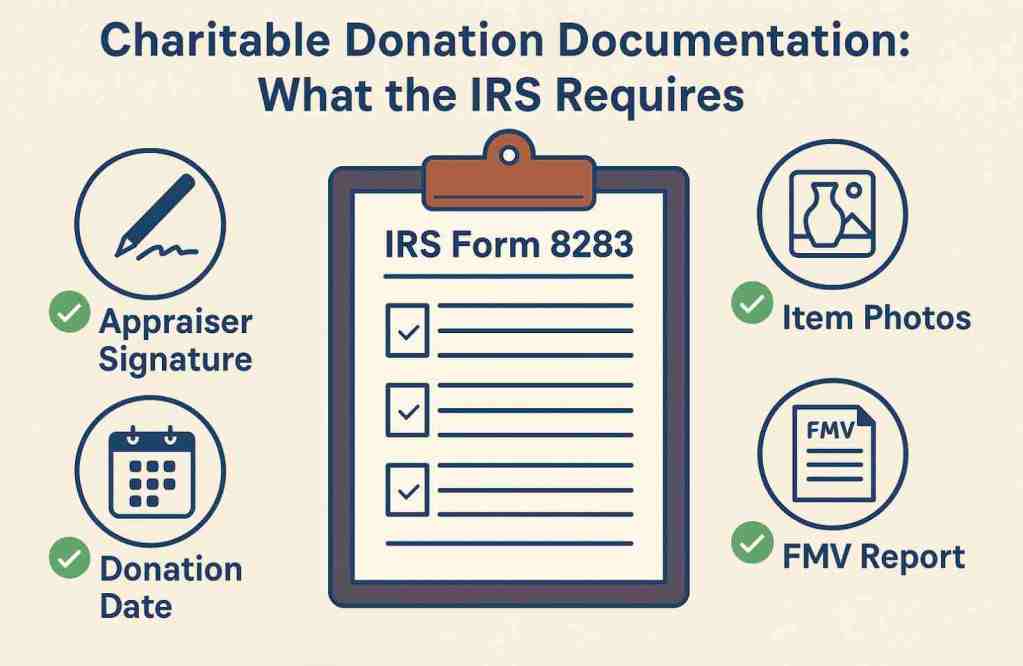
Form 8283 plays a crucial role in reporting non-cash charitable contributions. This form must include:
- Description of donated property
- Physical condition
- Date of contribution
- Original acquisition date
- Cost basis information
- Qualified appraiser’s signature
Factors Considered in Valuation
The valuation process considers multiple factors:
- Recent sales of comparable items
- Current market conditions
- Item condition and authenticity
- Historical significance
- Provenance documentation
Timing of Qualified Appraisal
A qualified appraisal must be completed no earlier than 60 days before the donation date and no later than the tax return due date. These strict requirements underscore the importance of working with certified appraisers who understand IRS compliance standards and can produce legally defensible valuations.
Other Contexts for Appraisal Services
It’s also noteworthy that similar appraisal services are applicable in other contexts, such as during divorce or separation, where equitable distribution appraisals provide accurate valuations for shared property to ensure fair asset division.
The Importance of Certified Personal Property Appraisals for IRS Compliance
Certified personal property appraisals are essential for meeting IRS requirements. They must follow strict professional standards, such as the Uniform Standards of Professional Appraisal Practice (USPAP), which outline the guidelines that accredited appraisers must adhere to in order to create legally defensible valuations.
Key Requirements for IRS-Compliant Appraisals:
- Detailed item descriptions with physical characteristics
- Comprehensive market research and analysis
- Clear explanation of valuation methodologies
- Appraiser’s qualifications and credentials
- Digital photographs of significant items
- Signature and certification statements
Certified personal property appraisals protect donors by providing thorough documentation that meets IRS scrutiny. These reports include market data analysis, condition assessments, and detailed explanations supporting assigned values.
Professional appraisers maintain independence and objectivity, ensuring unbiased valuations that stand up to legal challenges. Court-ready reports prove invaluable when:
- Responding to IRS audits
- Supporting tax return positions
- Defending claimed deductions
- Providing evidence in legal proceedings
Attorneys and fiduciaries rely on professionally prepared reports to protect their clients’ interests. These comprehensive documents include supporting evidence, market research, and clear methodologies that demonstrate compliance with IRS requirements and professional standards.
Key Factors in Determining the Value of Donated Personal Property Items
Determining the Fair Market Value (FMV) of donated personal property requires careful analysis of multiple valuation factors. Professional appraisers examine:
1. Recent Comparable Sales
Appraisers look at recent sales of similar items to get an idea of their value. This includes:
- Auction results
- Private market transactions
- Retail prices for similar items
- Geographic market variations
2. Current Market Conditions
The overall state of the market can also affect the value of donated items. Appraisers consider factors such as:
- Supply and demand dynamics
- Economic indicators
- Collector interest levels
- Seasonal market fluctuations
3. Item-Specific Factors
Each item being valued has its own unique qualities that can impact its worth. Appraisers take into account:
- Physical condition
- Provenance and documentation
- Rarity and uniqueness
- Age and historical significance
Different types of personal property require different approaches to valuation. Here are some examples:
Fine Art Valuation
When valuing fine art, appraisers analyze factors such as:
- Artist reputation
- Exhibition history
- Market positioning
Antique Furniture Valuation
For antique furniture, appraisers consider:
- Period authenticity
- Craftsmanship
- Restoration status
Collectibles Valuation
Valuing collectibles involves researching:
- Edition numbers
- Completeness of sets or collections
- Current preferences among collectors
Replacement cost considerations are important when there isn’t enough comparable sales data available. Appraisers look at various factors to determine how much it would cost to replace an item, including:
- Manufacturing costs
- Material values
- Craftsmanship quality
- Current retail pricing
- Import/export factors
Professional appraisers make adjustments based on depreciation (decrease in value over time), obsolescence (loss of value due to outdatedness), and market demand to arrive at an accurate FMV determination for charitable donation purposes, which is a crucial aspect of the donation process.
Valuation Guidelines for Different Types of Donated Personal Property Items
Used Household Items and Clothing
- Items must be in “good” or better condition per IRS requirements
- Standard household items receive 15-30% of retail value based on condition
- Gently used clothing typically values at 20-25% of original purchase price
- Luxury brand items may retain higher percentages of original value
- Documented purchase receipts strengthen valuation support
Fine Art, Antiques, and Collectibles
Professional art appraisals require specialized expertise in:
- Artist history and market performance
- Authentication and provenance verification
- Current auction results analysis
- Gallery and dealer price comparisons
High-Value Items Requiring Expert Valuation
- Original paintings and sculptures
- Limited edition prints
- Period furniture and decorative arts
- Rare books and manuscripts
- Estate jewelry and precious metals
- Historical memorabilia
Valuation Documentation Requirements
- Detailed condition reports
- High-quality photographs
- Comparable sales evidence
- Authentication certificates
- Provenance documentation
- Market analysis support
Prestige Estate Services’ accredited appraisers maintain extensive databases of comparable sales and market data across all personal property categories. This comprehensive approach ensures accurate valuations that meet IRS requirements while maximizing allowable deductions for charitable donations.
Timing and Documentation Requirements for Donors Seeking Tax Deductions Through Charitable Donations
Timing is critical when it comes to getting tax deductions for charitable donations. The IRS has specific deadlines for getting qualified appraisals:
- Appraisals must be completed no earlier than 60 days before the donation date
- Reports must be received before the tax return due date (including extensions)
Essential Documentation Checklist:
- Written acknowledgment from the charitable organization including:
- Organization name
- Donation date
- Detailed description of donated items
- Statement regarding goods or services provided in return
- Qualified appraisal report containing:
- Comprehensive item descriptions
- Physical condition assessment
- Fair Market Value determination
- Appraiser’s qualifications
- Signature and certification
For donations exceeding $5,000, Form 8283 Section B requires:
- Appraiser’s signature
- Donee organization acknowledgment
- Detailed property description
- Cost basis information
Missing deadlines or incomplete documentation can result in denied deductions. The IRS closely examines charitable contribution claims, making proper timing and thorough documentation essential safeguards for donors seeking tax benefits.
How Prestige Estate Services Supports Generous Donors with IRS-Compliant Personal Property Appraisals
Prestige Estate Services has a wide network of accredited personal property appraisers throughout the United States. Each appraiser has specialized knowledge to assist high-net-worth donors. Our appraisers have credentials from respected organizations such as:
- The International Society of Appraisers (ISA)
- The Appraisers Association of America (AAA)
- The American Society of Appraisers (ASA)
These qualifications ensure that donors receive accurate valuations that meet strict IRS requirements for charitable contributions.
Our team provides court-ready appraisal reports that include:
- Detailed descriptions and assessments of the item’s condition
- In-depth market analysis with data on comparable sales
- Clear explanations of the methods used to determine values
- High-quality photographs documenting the donated items
- Professional formatting that meets legal standards
Prestige Estate Services customizes each appraisal according to the specific needs of generous donors, whether it involves valuing individual items or large collections. Our appraisers collaborate directly with donors, attorneys, and charitable organizations to ensure smooth documentation processes.
The firm’s commitment to excellence goes beyond basic compliance – we offer strategic advice on the best timing and documentation strategies to maximize legitimate tax benefits while fully adhering to IRS regulations. Our reports go through thorough internal review processes to ensure accuracy and defensibility.
Related Appraisal Services Offered by Prestige Estate Services that Support Comprehensive Wealth Planning for Generous Donors
Prestige Estate Services offers a wide range of personal property appraisal services beyond just charitable donations. Our estate tax appraisals are crucial for federal and state tax filings, ensuring clients meet IRS requirements while safeguarding family wealth.
Our specialized services include:
- Insurance Coverage Appraisals: Accurate valuations ensuring proper protection of valuable assets
- Divorce Settlement Appraisals: Equitable distribution assessments for marital property
- Collection Management Services: Professional inventory and valuation of large collections
- Litigation Support: Expert witness testimony and court-ready documentation
- Appraisal Review Services: Independent analysis of existing appraisal reports
Each service follows USPAP standards and IRS requirements, carried out by our team of accredited appraisers. We collaborate closely with wealth managers, tax professionals, and estate planning attorneys to incorporate personal property valuations into comprehensive wealth management strategies.
Our nationwide reach enables us to assist clients with multiple properties and locations, delivering consistent, professional service regardless of the geographic distribution of assets. For more information or to schedule a consultation, please contact us.
Appraiser Overview:
Charitable donations are a great way to support causes you care about and also get tax benefits. To make the most of these benefits, it’s important to have expert help and proper documentation that follows IRS rules.
At Prestige Estate Services, our accredited appraisers are here to help generous donors like you with:
- Professional valuation reports that meet strict IRS requirements
- Expert guidance on complex personal property donations
- Court-ready documentation to protect your charitable deductions
- Nationwide service tailored to your specific needs
Don’t risk losing out on your charitable contribution deductions. Instead, work with qualified professionals who understand the ins and outs of personal property appraisals. At Prestige Estate Services, we provide the expertise and documentation you need to support your philanthropic goals while staying fully compliant with IRS regulations.
Want to safeguard your charitable donations with professional appraisal services? Get in touch with Prestige Estate Services today for a consultation with our accredited appraisers. We’ll walk you through the process and provide you with the thorough, IRS-compliant documentation that your generous donations deserve.
FAQs (Frequently Asked Questions)
What is the importance of charitable donation appraisals for generous donors?
Charitable donation appraisals are crucial for generous donors as they ensure IRS compliance, maximize tax benefits, and provide accurate valuations of noncash donations. Certified personal property appraisals help substantiate deductions and meet IRS documentation requirements.
When is a qualified appraisal required for charitable donations?
A qualified appraisal is required by the IRS when the claimed deduction for a noncash donation exceeds certain thresholds. Donors must obtain this appraisal from an accredited appraiser and submit it along with Form 8283 to comply with IRS rules.
How do certified personal property appraisals ensure IRS compliance?
Certified personal property appraisals performed by accredited appraisers adhering to USPAP standards produce legally defensible, court-ready reports. These appraisals validate fair market value determinations, ensuring that donors meet IRS documentation requirements and protect against potential audits.
What factors influence the valuation of donated personal property items?
Valuation factors include recent sales of comparable items, current market conditions at the time of donation, replacement costs, item type, and condition. These considerations help determine the fair market value (FMV) used in charitable donation appraisals.
Why are professional appraisals necessary for fine art, antiques, and collectibles?
Fine art, antiques, and collectibles possess unique characteristics and often have higher values that require specialized knowledge to accurately assess. Professional appraisals ensure precise FMV determination essential for IRS compliance and maximizing tax deductions.
What documentation and timing should donors consider when seeking tax deductions for charitable donations?
Donors must obtain qualified appraisals before filing their tax returns or extensions claiming deductions. Required documentation includes detailed appraisal reports prepared by accredited appraisers and charity receipts to substantiate the claimed deductions in accordance with IRS guidelines.